Dexterous manipulation data
Training data for robot hands.
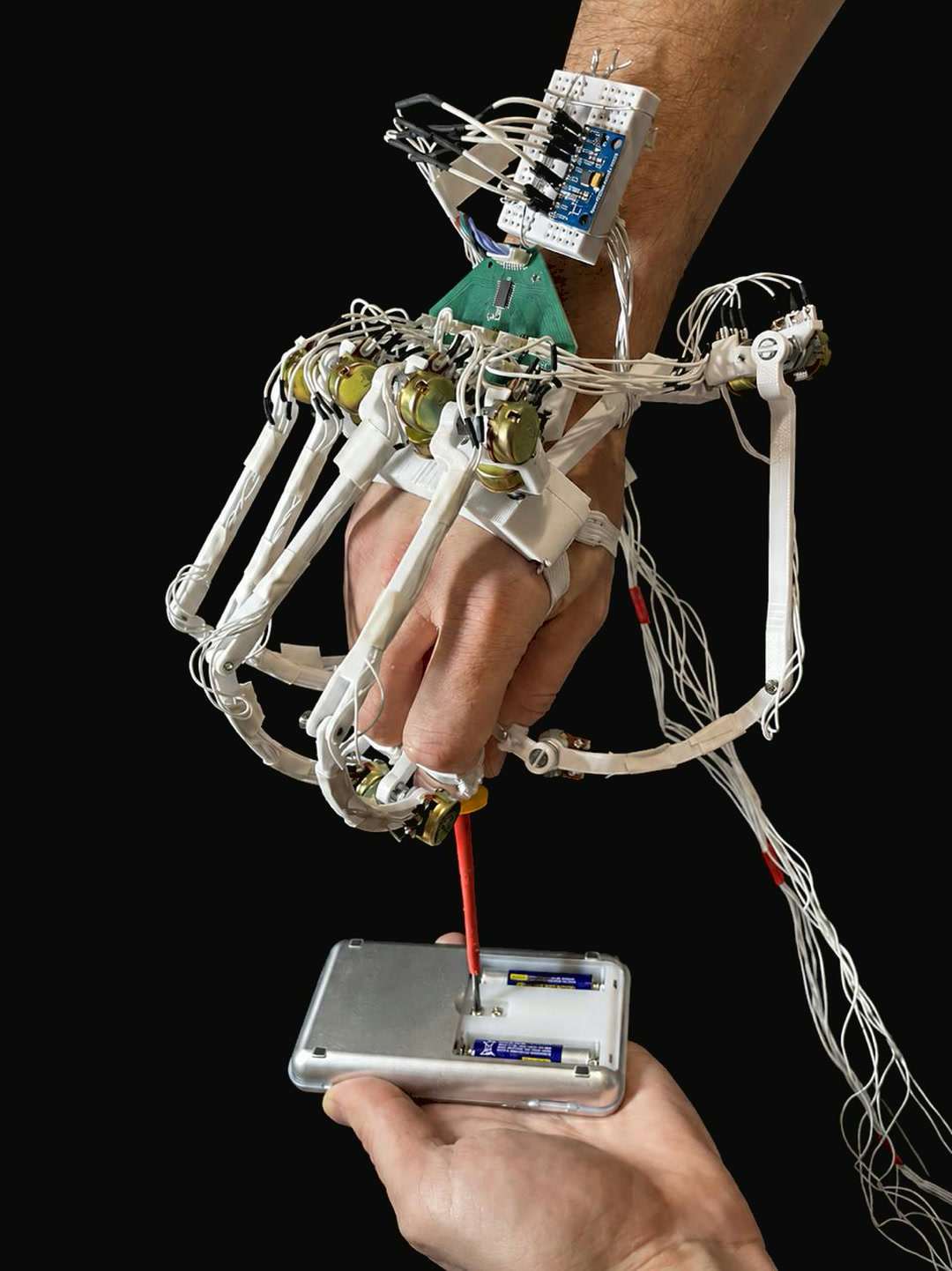
Grasp puts an instrumented glove on people who already have the skill and records what their hands do. Teams training manipulation policies license the result — at a fraction of what teleoperation costs.
Working prototype · recording with our first design partners

- 18
- channels
- 60 Hz
- sample rate
- ±1.5°
- angular accuracy
- $300
- cost to build
The proof
One take, two views, same frame.
Left: the glove on a hand. Right: what the software reconstructed from its channels at that instant, thumb included. Both recordings come from one session, aligned by cross-correlating motion — nothing is re-enacted.
On a robot hand
The same joint angles, on a Unitree Dex5-1.
Recorded angles retargeted onto Unitree’s five-finger hand in simulation: the hand closes, the robot hand closes. The glove drives the fingers and the hand’s orientation; position comes from the keyboard, because potentiometers measure joints, not where your arm is.
What you can buy
Two instruments, four ways in.
A camera tells you the hand closed; the glove tells you by how many degrees. Cameras give coverage, the glove gives the number, and most teams end up wanting some of each.
Capture
Your camera, your machine, your files — wrist path and grasp aperture, labelled by confidence.
Capture Pro
The same capture, hosted: sessions kept, calibration carried between them, provenance on file.
Glove
Eighteen channels at sixty hertz, ±1.5° after calibration — the number a camera cannot give you.
Pilot
You name the task. We find the expert, put the glove on them, and hand back fifty sessions.
A full programme — your task, your hand, as many hours as the policy needs.
from $27,000
Where this goes
Skills that were never written down.
A joiner knows how much pressure a chisel takes before the grain tears. None of that lives in a video dataset, because none of it is visible — it lives in the hand. Putting gloves on experts while they work is what we are building towards, and the domains below are where we want to start.
- Joinery
- Watchmaking
- Leatherwork
- Kitchen work
- Your domain
None of these are captured at volume today. They are where the glove goes once it is cheap enough to hand to a hundred people, which is the whole reason it is built the way it is.
Who is building this

The hardest part of teaching a robot to work with its hands was never the model. It is that almost nobody has recorded enough real hands doing real work — the rigs that can do it cost more than the robots. We built ours cheap enough to put on a hundred people instead of one, and we are recording the first sessions now.
with Dmytro Nalyvaiko, co-founder
Access
Tell us what to record.
Name the task and we come back with what it would take to record it: which expert, how many hours, and what the first batch looks like. Craftsmen willing to be recorded are equally welcome — you are the other half of this.